


Let's skip the pleasantries. One question, and don't lie to yourself:
What was actually wrong with the phone you owned before your latest one?
If the honest answer is "nothing, I just wanted the new one," congratulations. You are exactly the customer these companies dream about. Stay with me for a few minutes. I'll show you where your money goes, what you really got for it, and how to stop being an easy target. By the end, you'll know when an upgrade makes sense and when you're just paying $1,200 for a week of excitement.
1. The Emperor's New Camera Bump
Picture the launch event. Dark stage, dramatic music, and a presenter in a plain black t-shirt calling a lens "revolutionary" because it grew by a few millimeters.
They aren't technically lying. The camera is better. But is it $1,200 better? Not even close.
The very first iPhone in 2007 cost $499 and did things nobody had seen before: a full touchscreen and a real web browser in your pocket. That was a genuine leap. Today's flagship (the top-of-the-line model) costs more than double, and the big reveal is a slightly brighter screen and a slightly sharper photo of your lunch.
Be honest: when the last "game-changing" phone arrived, did your life change? Or did you take the same photos and scroll the same apps on a shinier slab?
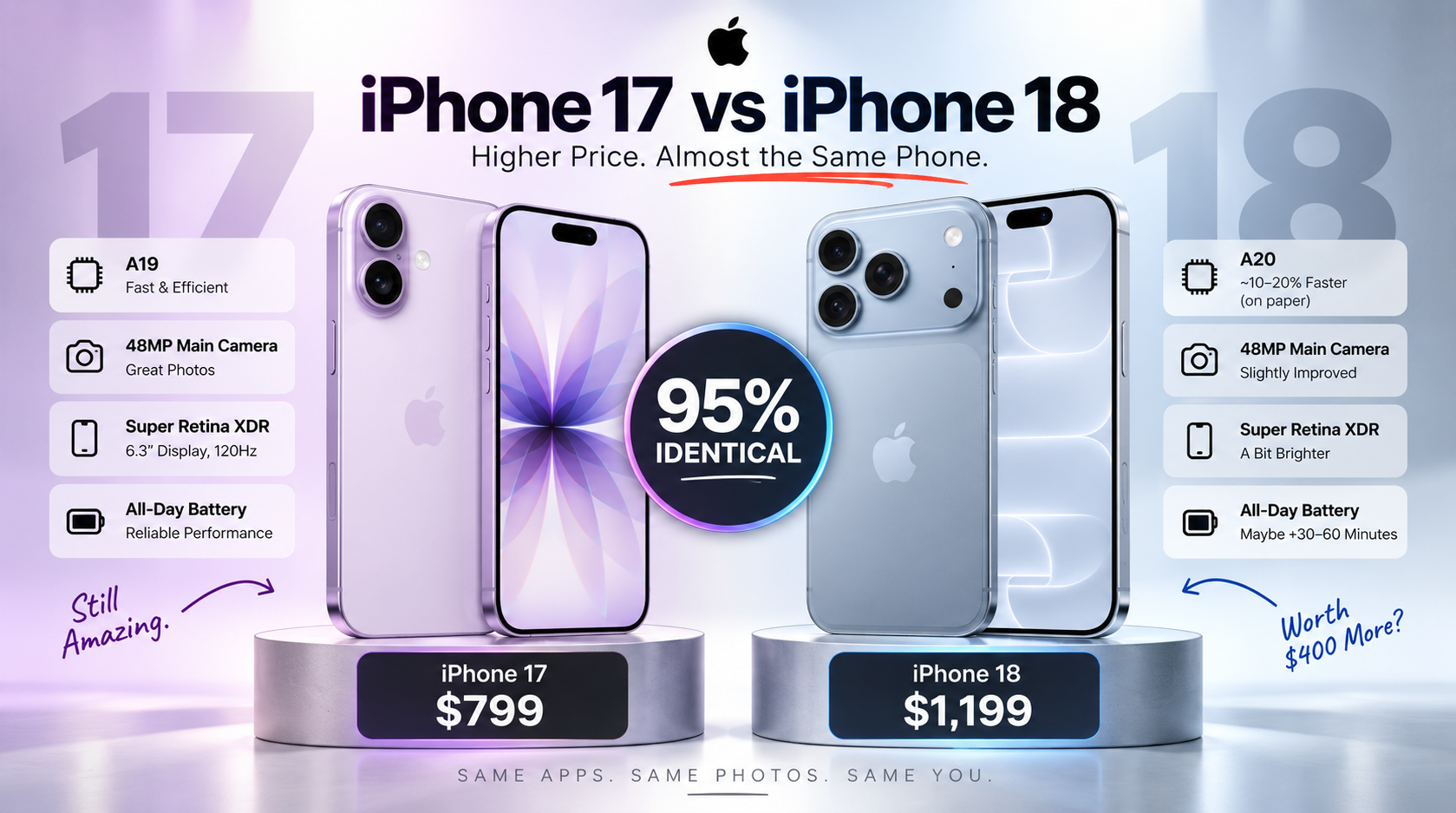
2. Side by Side: Last Year's Flagship vs. This Year's "Revolution"
Let's not compare against an ancient phone. That would be an easy win for the new one. Let's compare against the model the company sold you twelve months ago. The figures are approximate and vary by brand, but the pattern repeats every cycle.
| What you care about | Last year's flagship | This year's flagship | Difference you'd actually feel |
|---|---|---|---|
| Speed of apps | Instant | Instant | None |
| Processor (the phone's "brain") | Top of the line | Roughly 10-20% faster on paper | Invisible in daily use |
| Main camera (daylight) | Excellent | Excellent, slightly tweaked | You'd need a side-by-side zoom to notice |
| Screen | Sharp, bright, smooth | Sharp, bright, smooth (maybe a touch brighter) | Barely |
| Battery life | A full day | A full day (maybe +30-60 minutes) | Small |
| Software updates | Years of support left | Years of support left | None |
| Design | Great | New color, slightly different frame | Purely cosmetic |
| Price | Often $100-$300 cheaper now | $1,000-$1,200+ | Huge |
Read that last row again. The phone you'd be "upgrading from" is a near-twin of the new one, and it just got cheaper. The new one asks for full price in exchange for a speed bump your thumbs will never feel.
Here's a quick test. If you own last year's model, ask yourself what this year's version does that you cannot do today. Take your time. I'll wait.
If the honest answer is "slightly nicer photos in dim light," you're being asked to spend $1,000+ to fix a problem you didn't know you had until an ad announced it.
3. When Did Smartphones Stop Surprising Us?
- 2007-2012: Touchscreens, app stores, front cameras, fast mobile internet. Every year felt like the future arriving.
- 2013-2017: Fingerprint unlock, waterproofing, much better cameras. Still exciting.
- 2018-2020: Face unlock, 5G (the newest generation of mobile internet), night-mode photos. Decent.
- 2021 to today: A new shade of titanium. A button that now does something different. A slightly better everything.
The early years gave us new abilities. The recent years give us new versions of the same abilities, with a bigger price tag stapled on.
Compare a car from two years ago with this year's. Slightly nicer seats, maybe. Phones reached that stage a while back. The industry just doesn't want to say it out loud, because "it's about the same" doesn't sell 200 million units.
4. Inside the Hype Machine
If phones barely change, why does everyone treat every launch like a life event? Because you're being handled.
The drip of leaks. Months before launch, "rumors" flood your feed. Many are conveniently timed. It's free advertising disguised as gossip.
The limited colors. A "special edition" shade? Millions get made. It's not rare. It's a paint job.
The rigged comparison. Ever notice ads bragging "40% faster than the phone from 3-4 years ago"? They almost never compare against last year's model, because the honest pitch would be "about the same." They pick an old victim to make themselves look good.
FOMO (fear of missing out). Your friend pulls out the new model and yours suddenly feels ancient. It isn't. It's the same phone that was perfectly fine yesterday. Only your mood changed, and someone spent millions engineering that mood.
Here's the uncomfortable question: a week after your last upgrade, was anything in your life measurably better? Or did you just own a nicer thing to feel briefly good about?
5. The Camera Myth: Do You Really Need 200MP for Brunch Photos?
Cameras are the number one selling point, so let's give them a fair trial.
Megapixels (the number of tiny dots that build a photo) sound impressive. Yet for years, top phones used about 12MP and took stunning pictures. Now we see 48MP, 108MP, even 200MP sensors (the part that captures light).
On a phone screen, or even a large TV, most people can't tell a 12MP photo from a 200MP one in normal use. Nobody at your dinner table is zooming into the pixels of your pasta. What actually makes a photo good is:
- Light: how big the sensor is and how much light it gathers
- Processing: the software that cleans up and sharpens the image
- You: framing, timing, and steady hands
Processing improves through software updates, which often reach older phones too. Unless you print billboard-sized posters, a giant megapixel count is a number on a spec sheet designed to make you feel smart for paying more.
6. Where Your Money Really Goes
What do you think it costs to build a $1,200 phone?
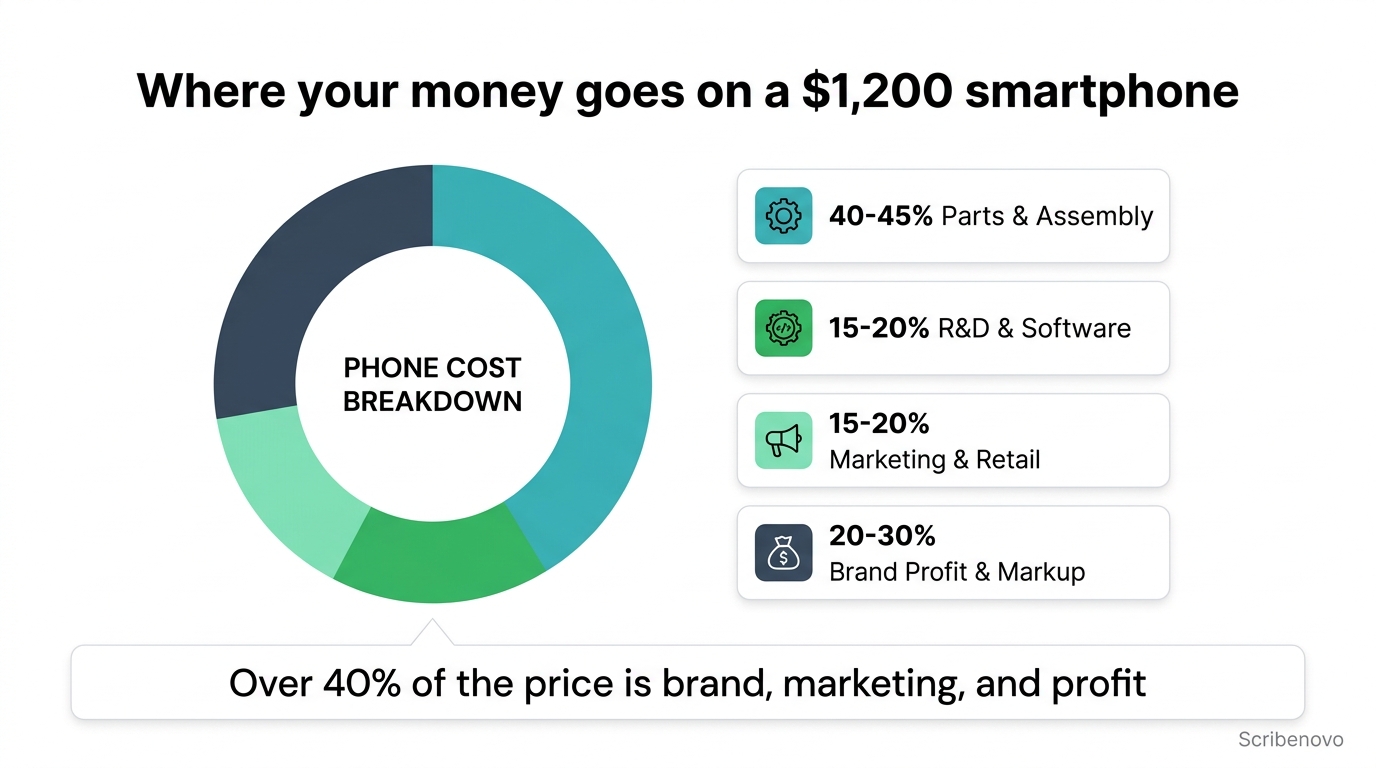
Independent teardown analysts, who take phones apart and price every component, generally estimate the parts of a top-tier flagship at roughly $450 to $550. That's parts only, before design, software, marketing, shipping, and store margins.
Very roughly, here's where each $1,200 lands:
| Where your money goes | Approximate share |
|---|---|
| Parts and assembly | 40-45% |
| Research, software, design | 15-20% |
| Marketing, shipping, retail cut | 15-20% |
| Company profit | 20-30% |
Are these exact? No, companies keep their books private. But the message is clear: a large slice of what you pay is brand and profit, not hardware. That extra $300 for the "Pro" label rarely buys $300 of usefulness. Mostly it buys a logo and the feeling of being a "pro" at scrolling.
Companies have every right to earn money. You have every right to stop volunteering.
7. The Trade-In Trap
"Get the new phone for $0 down!" "Trade in your old one for up to $800 off!"
Read the fine print. Nobody is handing out free money.
Monthly installments (paying in small chunks) turn a $1,200 phone into a painless-sounding $33 a month. Same psychology as a gym membership. Thirty-six months of $33 is still $1,188. You didn't dodge the price. You just stopped looking at it.
Trade-in credit usually arrives as bill discounts spread over 24-36 months. Leave early and you can lose the remaining credits. That's the hook: you're locked in to that carrier, and when a cheaper plan appears elsewhere, you can't take it.
A "free" phone can quietly cost you hundreds in higher plan prices and lost freedom. Have you ever added up the total before signing? If not, do it next time. Ten minutes of math, and it might sting.
8. The Hidden Damage: Wallet, Drawer, and Planet
The United Nations has reported that the world generated about 62 million tonnes of e-waste (discarded electronics) in a single year. Only about 22% was properly collected and recycled. The rest was dumped, burned, or buried.
Here's the part most people miss: a phone's biggest environmental damage comes from making it, not using it. Manufacturers' own reports commonly show that around 80% of a phone's lifetime carbon footprint comes from mining materials and building the device.
So the greenest phone on Earth is the one already in your pocket. Every unnecessary upgrade adds to the pile.
Go open your drawer. How many dead phones are sitting in there? Now multiply that by hundreds of millions of people. Uncomfortable, isn't it?
9. The 4-Year Phone Plan
Enough guilt. Here's the fix.
Step 1: Make a rule. "I upgrade when my phone stops doing what I need, not when a new one launches." Write it down. Tape it to the box if you must.
Step 2: Check the support window. Many recent flagships promise 5 to 7 years of software updates (security fixes and new features). That's longer than most people keep a phone. Look up your model's end date. You probably have years left.
Step 3: Protect it. A decent case and screen protector cost around $30. A cracked-screen repair can run $200 or more. Do the math.
Step 4: Ignore launch season. Unfollow the leak accounts. Mute the hype. What you can't see, you can't crave.
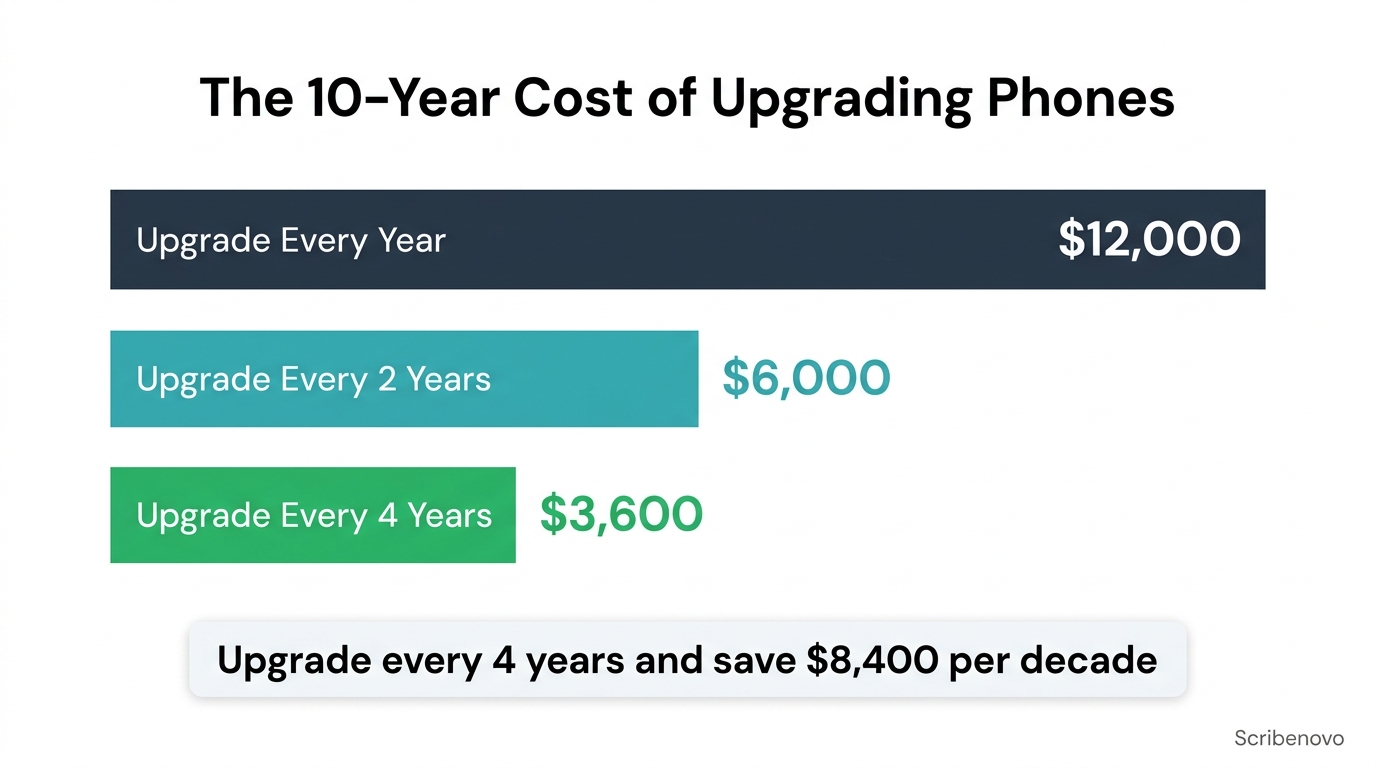
Now let's see what that does to your bank account. Assume phones cost a steady $1,200:
| Habit | Phones bought in 10 years | Total spent |
|---|---|---|
| Upgrade every year | 10 | $12,000 |
| Upgrade every 2 years | 5 | $6,000 |
| Upgrade every 4 years | 3 | $3,600 |
That's an $8,400 gap. A serious holiday. An emergency fund. Or, if you prefer, an expensive way to own nearly the same phone ten times.
10. Cheap Tricks That Make Your Old Phone Feel Brand New
"But my phone is slow!" Is it really, or is it just tired? Try these before spending a dime:
- Replace the battery. This is the big one. Batteries typically last roughly 500 to 1,000 full charge cycles (around 2-3 years of daily use) before fading. A replacement usually costs $50-$100 at an authorized repair shop and can make a "dying" phone feel new.
- Free up storage. A nearly full phone crawls. Delete apps you don't use and back up photos to the cloud (online storage).
- Restart weekly. Sounds silly, works well. It clears out small glitches that pile up.
- Update your software. Newer versions often fix speed problems.
- Factory reset once in a while. Back up first, then wipe the phone (return it to its original settings). Years of digital clutter vanish.
For around $100 or less, most "slow" phones get a second life. Compare that with $1,200.
11. The Smart Buyer's Playbook
Sometimes you truly do need a new phone. Fine. Just don't pay the "I saw an ad" price.
Option A: Last year's flagship. The moment a new model launches, the previous one usually drops $150-$300. And as we saw in the comparison table, it's practically the same phone.
Option B: Certified refurbished (professionally restored and tested). Reputable sellers repair used phones, often adding new batteries and warranties, at roughly 20-40% below new prices.
Option C: A mid-range phone. Today's $400-$600 phones handle calls, social media, streaming, maps, and everyday photos with ease. You give up a bit of camera finesse and screen polish. You keep about half your money.
Rule of thumb: about 95% of the experience for about 50% of the price. That last 5% is what you're charged the "premium" for.
12. So, When Is It Actually Worth Upgrading?
I'm not saying never upgrade. I'm saying stop doing it for silly reasons. Tick two or more of these and you have a real case:
- ✅ Your phone no longer gets security updates. This matters for your banking apps.
- ✅ The battery barely lasts half a day even after a replacement.
- ✅ Your important apps crash or won't install.
- ✅ The screen or body is damaged beyond a sensible repair cost (more than about 40-50% of a replacement's price).
- ✅ You have a genuine need, such as being a working photographer or video creator whose income depends on the camera.
If your reason is "it's new" or "my friend got one," you already know what that reason is worth.
So here's where we've landed, together.
Phones haven't gotten worse. They've become good enough that yearly upgrades barely change your day, while price tags kept climbing. The excitement is manufactured through launch events, leaks, and cherry-picked comparisons that make a perfectly fine phone feel outdated. A big part of a $1,200 price is brand and profit. "Free upgrade" deals can chain you to pricier plans, and every needless upgrade feeds a mountain of electronic waste. Meanwhile, a fresh battery, a case, and a little cleanup can give your current phone years more life. And if you do need a change, last year's model, a refurbished one, or a mid-range phone delivers nearly the same experience for far less.
So here's my challenge: skip your next upgrade. Just one. Move that money into savings and see whether you miss the new phone after three months.
I'm betting you won't. And when you notice that, come back and tell me. I'd love to know whether your wallet agrees.
A note on the numbers: prices, percentages, and lifespans in this post are approximate and based on widely reported industry estimates and company disclosures. They vary by brand and model. Check current figures for the specific phone you're considering.