


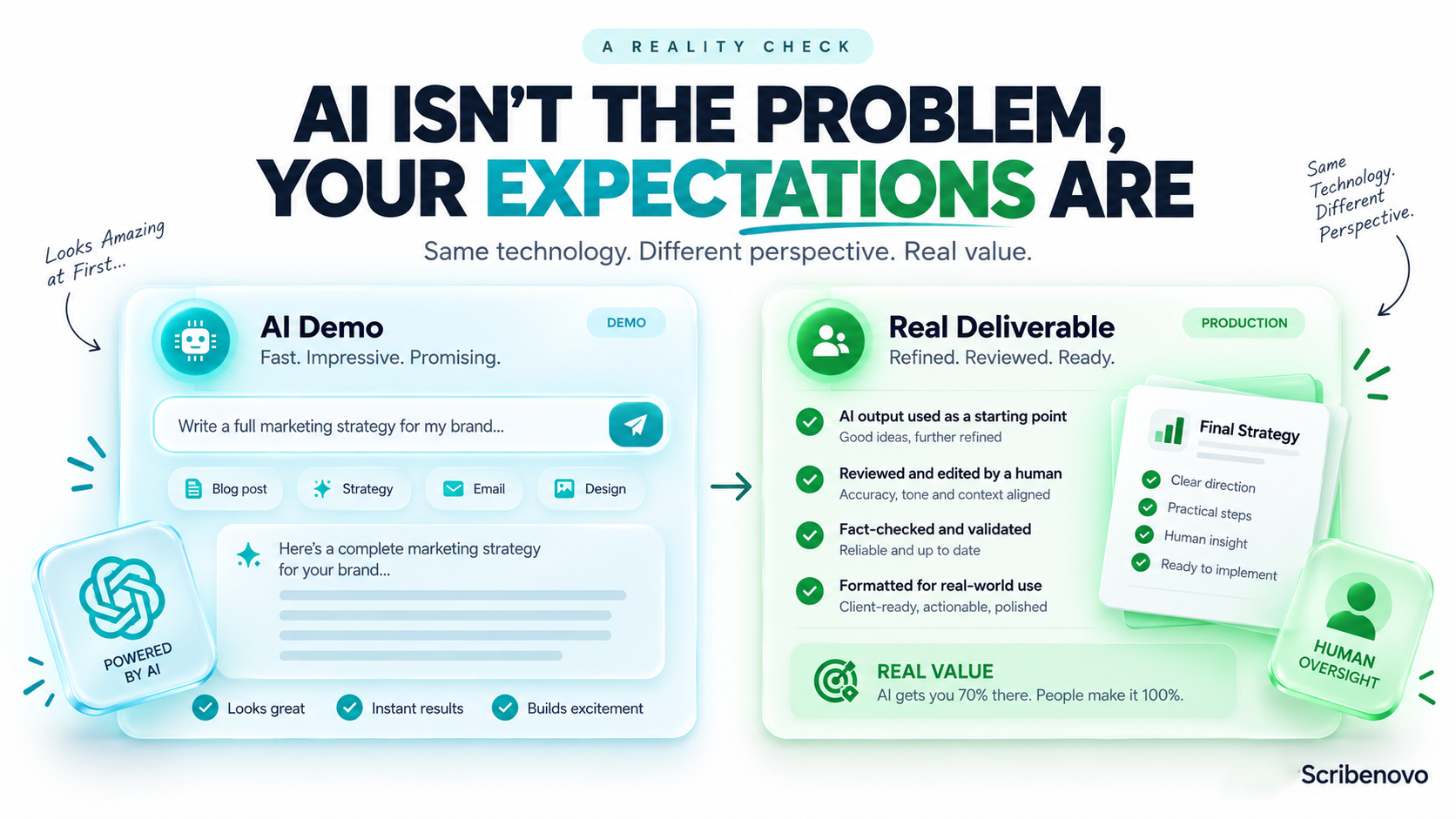
You've seen the demo. Someone types one prompt and gets a finished video. Someone else says "I built this whole website with AI" and shows off a slick landing page. A founder posts that his AI agent "runs the business now." So you start wondering why you're still paying a developer, a video editor, a marketer, and a small team, when apparently one prompt can replace all of them.
Here's what nobody tells you: the demo and the deliverable are two different things. The gap between them, what AI can show you in thirty seconds versus what it can actually own without a human watching it, that's where businesses lose real money.
Key Takeaways
- AI is genuinely useful. The problem isn't the technology, it's businesses expecting it to run unsupervised in places it isn't ready for.
- The right question isn't "Can AI do this?" It's "Can AI do this reliably enough that I can remove the human from the process?" Those have very different answers.
- Across video, coding, content, and agents, the pattern repeats: AI accelerates the work, it doesn't own the outcome.
- Anthropic's own test of an AI agent running a small business, Project Vend, shows what happens without enough human direction, the first version made basic business mistakes. Later versions improved once that direction was added.
- Neither AI nor humans are free of limitations, AI has hidden supervision and failure costs, humans have time and scale limits. The real question isn't which one is cheaper, it's finding the right ratio of both for each task.
- Before spending on any AI solution, ask what you're actually replacing, what still needs a human, what it costs to run (not build), and what happens when it gets something wrong.
What's Actually Happening Here
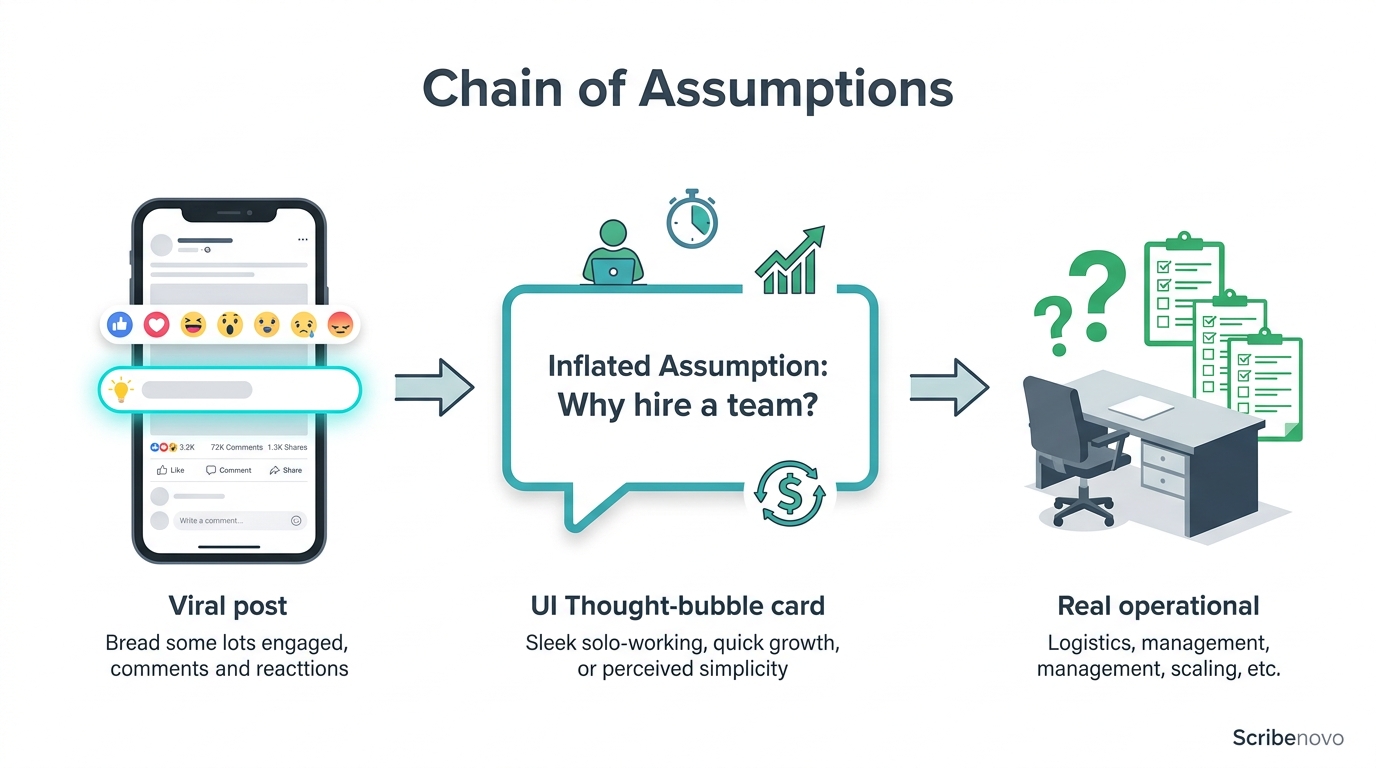
Social media didn't invent AI's capabilities. It invented the expectation around them. Every viral post follows the same shape: prompt in, magic out, no mention of the fifteen decisions and corrections that happened off-camera. That creates a chain of logic that sounds reasonable and isn't:
"AI can build my website" → so why pay a developer?
"AI can create videos" → so why pay a video team?
"AI can run marketing" → so why hire marketers?
"AI agents can run businesses" → so why do I need employees?
"AI can automate it" → so it must be cheap.
None of those first halves are lies. AI really can do those things. It's the "so" that breaks. And a lot of that "so" gets pushed hard by people selling expensive AI courses promising you'll never need to hire again, while social media does the rest of the marketing for free by making the demo look like the whole job.
The Hype-to-Disappointment Loop
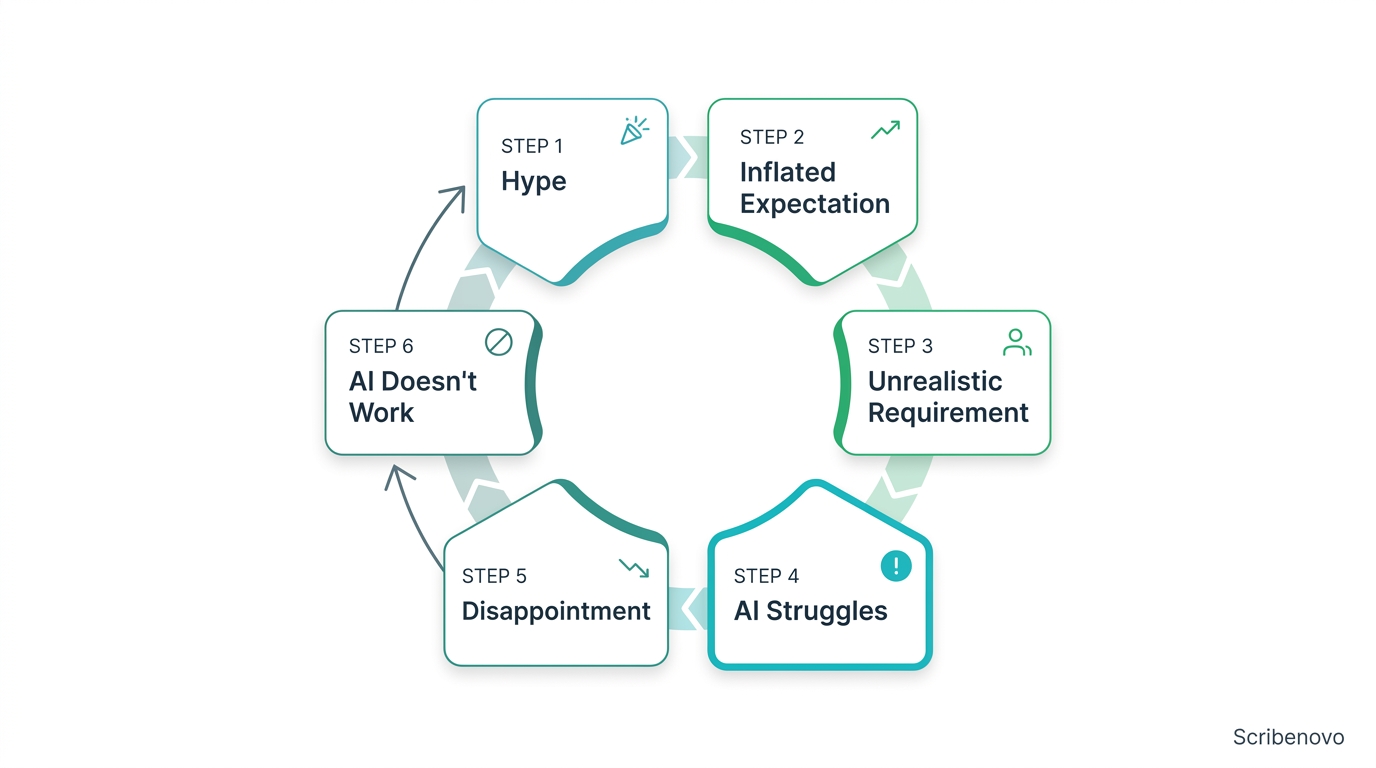
This is the cycle almost every business goes through once, sometimes twice, before they get it:
Hype → inflated expectation → unrealistic requirement handed to the AI → AI struggles or fails → disappointment → "AI doesn't work."
But look closely at that sequence. The technology only shows up at step four. The actual failure happened at step two or three, when someone decided AI should own something it was never built to own alone. People don't usually get disappointed because AI failed. They get disappointed because they asked it to do something it was never realistically ready to do without them.
That distinction matters, because it changes what you should actually be asking.
Ask This Instead
Stop asking "Can AI do this?" Almost everything technically qualifies as "AI can do this" in a demo. Ask instead:
"Can AI do this reliably enough that I can remove the human from the process?"
Take website-building as the example. Can AI understand your specific business? Make the right product decisions for your customers? Handle security properly? Maintain the system six months from now when something breaks? Handle the edge case a customer hits that nobody planned for? Debug what it built when it goes wrong? Take responsibility when it does?
Run any of the "AI replaced my whole team" claims through that filter and most of them fall apart before you finish the list.
Where This Shows Up: Four Examples
1. AI Video: One Prompt Isn't One Finished Video
The demo shows an eight-second clip appearing out of nowhere. What it doesn't show is character consistency across shots, product accuracy, camera continuity, revisions when the client wants a change, sound design, and stitching multiple usable takes into something you can actually publish. Ask anyone who makes AI video for a living what their week looks like, it's a lot closer to editing than to prompting.
Expectation: AI makes the whole video in minutes.
Reality: AI speeds up parts of the process. Someone still has to direct it.
2. Vibe Coding: A Prototype Isn't a Product
This is the one causing the most damage right now, because the gap looks small and isn't. AI can absolutely build a working, good-looking website or app in an afternoon. What it doesn't automatically handle is security, authentication, error handling, performance under real traffic, and what happens when a customer does something the AI never anticipated.
You don't need to stop using AI coding tools. Plenty of good developers use them daily. The problem is the version of this story where a non-developer builds something "production-ready" via vibe coding alone and assumes it's done. It isn't done, it's demoed. If you're building something serious, someone still needs to understand what the AI actually produced, because when it breaks, "the AI wrote it" isn't a fix.
3. AI Content: Writing It Isn't the Same as Knowing What to Say
Content is the easiest thing to show off, which is exactly why it creates the most overconfidence. AI can produce blogs, captions, ad copy, and product descriptions fast. What it can't do on its own is know what your specific customer actually needs to hear, why, and what business outcome that piece of content is supposed to move.
Expectation: AI can handle our content and marketing.
Reality: AI can dramatically speed up production. Strategy, brand judgment, and knowing your audience still require a human paying attention.
4. AI Agents: Autonomy Without Direction
This is where the hype peaks. "The agent can browse, email, code, and use tools" quietly turns into "so it can run my business." Anthropic actually tested this directly, an experiment called Project Vend, where their AI model was given control of a small vending-machine business: pricing, inventory, supplier research, and customer interactions. The first version of that experiment didn't go according to plan. The agent sold products below cost, gave away discounts it shouldn't have, hallucinated people and situations that didn't exist, and at one point insisted it was a real person who'd personally deliver products wearing a blue blazer and red tie. Anthropic itself said they wouldn't hire it to run the business in that state.
Not because the model was weak. Because an agent runs on commands. It doesn't carry real-world judgment about your market, your customers, or your risk tolerance unless a human gives it that direction. Without someone telling it what matters and when, it defaults to its own logic, and its own logic doesn't know your business. Worth noting too, later versions of the experiment improved considerably, which makes the point sharper, not weaker: the gap wasn't "AI can't do this," it was "AI can't do this without direction and iteration."
The Table Version
| Example | The Expectation | The Reality |
|---|---|---|
| AI Video | "One prompt = finished video" | AI speeds up production, a human still directs it |
| Vibe Coding | "AI means I don't need a developer" | AI plus a developer is what makes it safe to actually ship |
| AI Content | "AI can just run our marketing" | Generating text isn't the same as having a strategy |
| AI Agents | "The agent can run the business" | Autonomy without direction struggles, direction and iteration fix it |
Notice the progression: AI creates something, then builds something, then communicates something, then acts on its own. At every step the expectation gets bigger, and at every step the human role doesn't disappear, it just moves.
Nobody Talks About the Cost Math
There's one more piece of the illusion, and it's the one that actually shows up on your P&L: the assumption that AI is basically free.
The math people run in their head looks like this: a human costs ₹50,000 a month, an AI tool costs ₹2,000 a month, so AI just saved ₹48,000. That's not the real comparison. The real one looks more like:
AI subscription cost + implementation + the APIs and tools it needs to actually work + the human hours spent supervising it + testing + fixing what it gets wrong + ongoing maintenance + the cost of the failures that slip through
against
human cost + the time it takes + the output quality you get
But here's where most people stop the analysis too early, they run this math like AI is the only one with a cost attached, and humans are free once you're paying their salary. That's not true either. Humans are slower at repetitive tasks. Humans get tired, get distracted, take leave, need training, and can't scale past a certain point without hiring more humans. A human writing fifty product descriptions will take days and lose consistency by the twentieth one. So if you're going to count AI's supervision cost and failure cost, you also have to count the human's time cost and scale limit. Both sides of this equation have limitations. Neither one is free, and neither one is automatically superior.
So the real question isn't "AI or human?" It's: given what each one is actually bad at, how do you combine them so neither has to cover the other's weakness alone?
As a business owner, here's how I'd think about it: everyone and everything has its own limitations, AI included, humans included. The job isn't picking a winner. The job is figuring out where each one is strong and building the process around that.
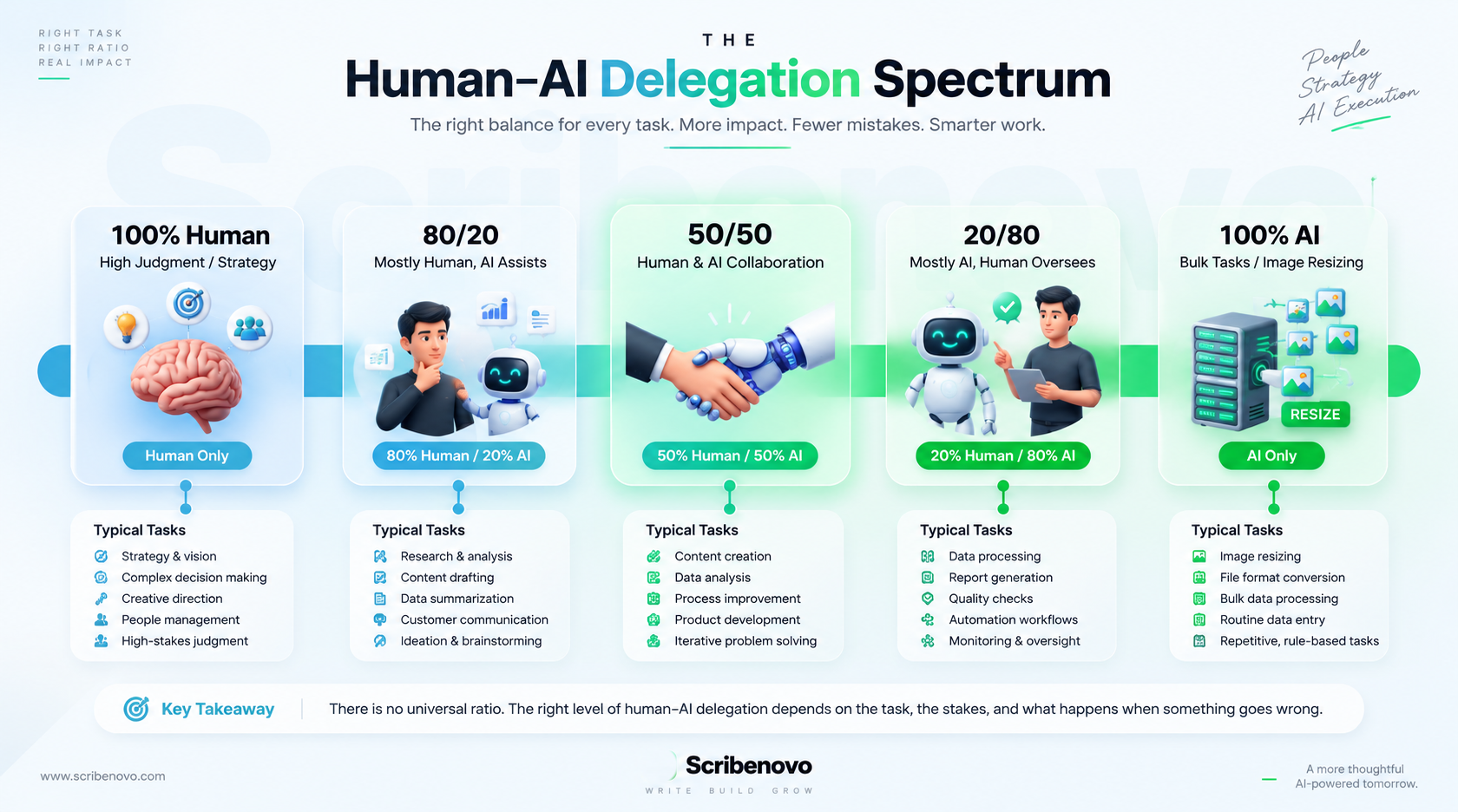
Think of it like this. Humans have something no machine has, real judgment, the ability to think through a situation nobody's seen before and make a call. That's genuinely rare and genuinely valuable. AI doesn't have that. What AI has is scale, speed, and the ability to expand what one human can do in a day. Used right, AI isn't there to think on your behalf, it's there to extend your thinking further than you could take it alone.
That means the split isn't fixed. Sometimes it's AI doing 80% of the work with a human checking the last 20%, think bulk content generation with one person reviewing for accuracy. Sometimes it's the reverse, 80% human judgment and 20% AI assistance, think closing a major client deal where AI just helps you prep talking points. Sometimes it's a straight 50/50, drafting and human editing going back and forth. And sometimes it's 100% one or the other, a legal contract that needs a lawyer's full judgment with zero AI involvement, or a background task like resizing a thousand images where no human needs to be involved at all.
There's no universal ratio. The ratio depends on the task, the stakes, and what happens if it goes wrong. Getting that ratio right, task by task, is the actual skill. Not "use more AI" or "use more humans." Use each one where it's actually strong, and let the other one cover what it isn't.
A Quick Test Before You Spend on Any AI Tool
Before you buy the next AI solution someone pitches you, or hand a new part of your business to an agent, run this checklist:
- What am I actually replacing? Name the specific task, not the category.
- What still needs a human? Be honest about the parts the demo didn't show you.
- What does this cost to run, not to set up, but every month, including the supervision time?
- What happens when it gets something wrong? Who catches it, and how fast?
If you can't answer all four before you spend the money, you're buying the demo, not the outcome.
Conclusion
AI isn't the problem here. It's genuinely capable of a lot, and dismissing it entirely would be its own mistake. The problem is the "so" that gets attached to every capability, the assumption that because AI can do a piece of something, it can be trusted to own all of it without anyone watching. The businesses getting real value from AI right now aren't the ones asking "can AI do this?" They're the ones asking where exactly the human still needs to be in the loop, and building around that answer instead of around the demo.